
Microecology and floristic diversity of seasonal wetlands of a lateritic plateau of South India
Article Sidebar
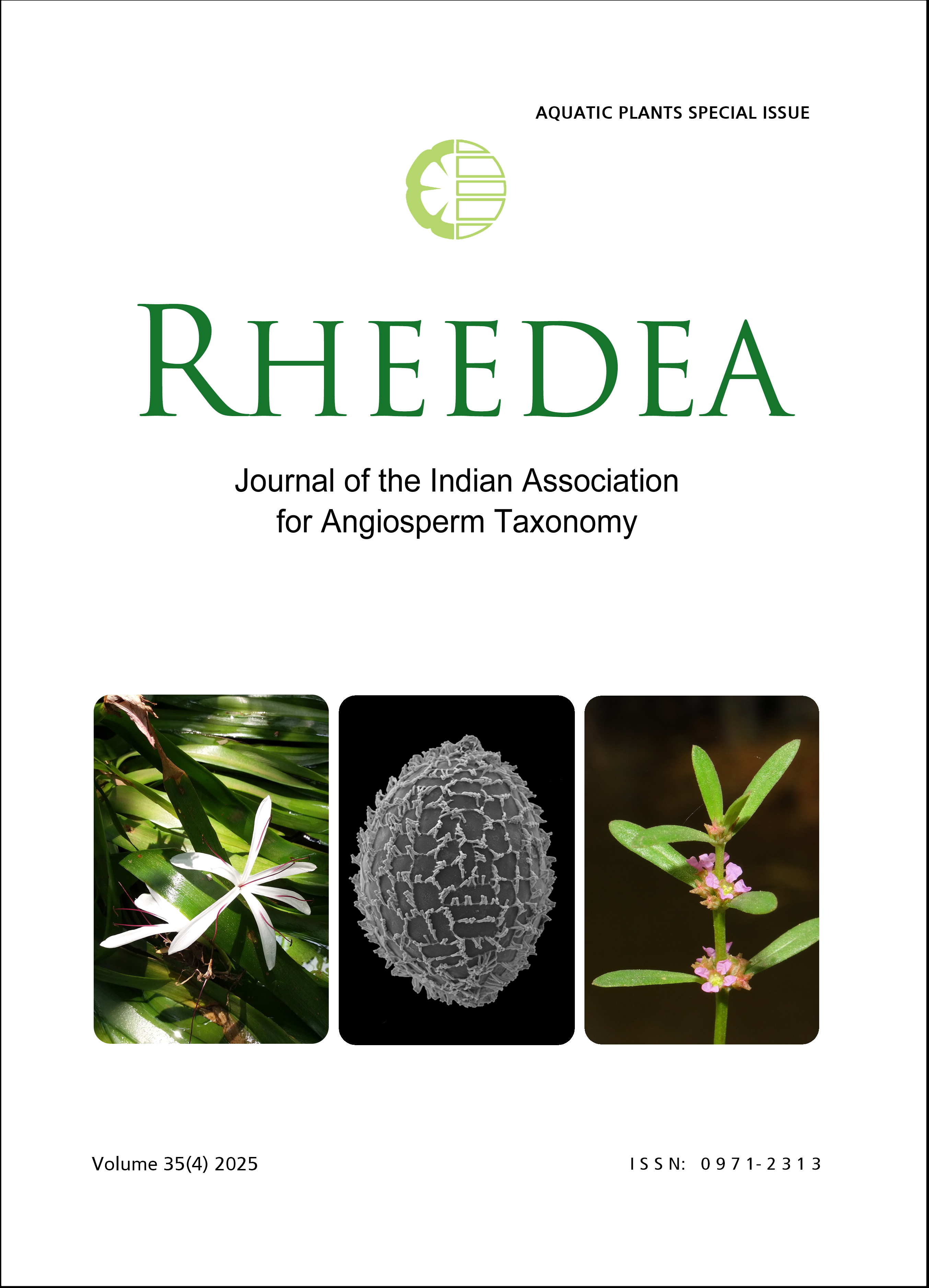
Main Article Content
Abstract
An analysis of the microecology and floristic diversity of the seasonal pools on the Madayippara lateritic plateau, located in Kannur District of Kerala, South India, was conducted. Temporary wetlands of varying sizes are formed during the rainy season, supporting a large number of habitat-specific flowering plants, a greater number of which are endemic, and a few belong to various threat categories. The seasonal pools vary in their size, soil cover and texture, and are subjected to extreme diurnal changes in temperature due to the high surfaceto-volume ratio. They are characterised by high variation in soil temperature and water pH between pools and between seasons, extreme variation of water temperature in different seasons and in different hours of a day, and also hold maximum moisture content with extreme variation in different seasons. The soil type in most of the seasonal pools is sandy loam, and is the richest with respect to soil nutrients. The occurrence of high diversity of carnivorous plants in these nutrient-rich habitats is ascribed to the limitation in nutrient absorption, resulting from factors such as low pH, inundation and low phosphorus levels. Seasonal pools are highly specialised microhabitats active only in the monsoon period to support several specialised species showing a high degree of endemism owing to their characteristic microecology.
Article Details
Section

This work is licensed under a Creative Commons Attribution-NonCommercial-NoDerivatives 4.0 International License.
How to Cite




References
BERGER K.C. & E. TRUOG 1939. Boron determination in soils and plants. Industrial Engineering Chemistry and Analytical Edition 11: 540–545. DOI: https://doi.org/10.1021/ac50138a007
BHATTARAI U., TETALI P. & S. KELSO 2012. Contributions of vulnerable hydrogeomorphic habitats to endemic plant diversity on the Kas Plateau, Western Ghats. SpringerPlus 1–25. DOI: https://doi.org/10.1186/2193-1801-1-25
BUCHANAN F. 1807. A journey from Madras through the countries of Mysore, Kanara and Malabar. W. Bulmer & Co., London.
DICK D.A. & F.S. GILLIAM 2007. Spatial heterogeneity and dependence of soils and herbaceous plant communities in adjacent seasonal wetland and pasture sites. Wetlands 27(4): 951–963. DOI: https://doi.org/10.1672/0277-5212(2007)27[951:SHADOS]2.0.CO;2
GODEFROID S., MONBALIU D. & N. KOEDAM 2007. The role of soil and microclimatic variables in the distribution patterns of urban wasteland flora in Brussels, Belgium. Landscape and Urban Planning 80: 45–55. DOI: https://doi.org/10.1016/j.landurbplan.2006.06.001
JACKSON M.L. 1958. Soil Chemical Analysis. Prentice-Hall Inc., Englewood Cliffs.
JOCQUE M., VANSCHOENWINKEL B. & A. BRENDONCK 2010. Freshwater rock pools: a review of habitat characteristics, faunal diversity and conservation value. Freshwater Biology 55: 1587–1602. DOI: https://doi.org/10.1111/j.1365-2427.2010.02402.x
JOSHI V.C. & M.K. JANARTHANAM 2004. The diversity of life-form type, habitat preference and phenology of the endemics in the Goa region of the Western Ghats, India. Journal of Biogeography 31: 1227–1237. DOI: https://doi.org/10.1111/j.1365-2699.2004.01067.x
KEELEY J.E. & P.H. ZEDLER 1998. Characterization and Global Distribution of Vernal Pools. In: WITHAM C.W., BAUDER E.T., BELK D., FERREN JR. W.R. & R. ORNDUFF (Eds.), Ecology, Conservation, and Management of Vernal Pool Ecosystems – Proceedings from a 1996 Conference. California Native Plant Society, Sacramento. pp. 1–14.
KRIEGER A., POREMBSKI S. & W. BARTHLOTT 2003. Temporal dynamics of an ephemeral plant community: species turnover in seasonal rock pools on Ivorian inselbergs. Plant Ecology167: 283–292. DOI: https://doi.org/10.1023/A:1023988411575
LANYON L.E. & W.R. HEALD 1982. Magnesium, calcium, strontium and barium. In: A.L. PAGE, R.H. MILLER & D.R. KEENEY (eds.), Methods of soil analysis. Part 2: Chemical and Biological Properties. Series Agronomy No. 9. American Society of Agronomy, Madison. pp. 247–273. DOI: https://doi.org/10.2134/agronmonogr9.2.2ed.c14
LEKHAK M.M. & S.R. YADAV 2012. Herbaceous vegetation of threatened high altitude lateritic plateau ecosystems of Western Ghats, Southwestern Maharashtra, India. Rheedea 22(1): 39–61. https://dx.doi.org/10.22244/rheedea.2012.22.01.12
MCLEAN E.O. 1982. Soil pH and lime requirement. In: A.L. PAGE, R.H. MILLER & D.R. KEENEY (eds.), Methods of soil analysis. Part 2: Chemical and microbiological properties. Series Agronomy No. 9. American Society of Agronomy, Madison. pp. 199–223. DOI: https://doi.org/10.2134/agronmonogr9.2.2ed.c12
MESSIAS M.C.T.B., LEITE M.G.P., NETO J.A.A.M., KOZOVITS A.R. & R. TAVARES 2013. Soil-Vegetation Relationship in Quartzitic and Ferruginous Brazilian Rocky Outcrops. Folia Geobotanica 48: 509–521. https://doi.org/10.1007/s12224-013-9154-4 DOI: https://doi.org/10.1007/s12224-013-9154-4
MULLER J.V. 2007. Herbaceous vegetation of seasonally wet habitats on inselbergs and lateritic crusts in West and Central Africa. Folia Geobotanica 42(1): 29–61. https://doi.org/10.1007/BF02835101 DOI: https://doi.org/10.1007/BF02835101
PARMENTIER I. 2003. Study of the vegetation composition in three inselbergs from continental Equatorial Guinea (Western Central Africa): Effects of site, soil factors and position relative to forest fringe. Belgian Journal of Botany 136(1): 63–72.
POREMBSKI S. 2007. Tropical Inselbergs: habitat types, adaptive strategies and diversity patterns. Revista Brasileira de Botânica 30(4): 579–586. https://doi.org/10.1590/S0100-84042007000400004 DOI: https://doi.org/10.1590/S0100-84042007000400004
PRAMOD C. & A.K. PRADEEP 2020. A Hillock of Biodiversity: Ecology and Flora of a South Indian Laterite Plateau. Indian Association for Angiosperm Taxonomy, Calicut.
PRAMOD C. & A.K. PRADEEP 2021. Observations on the flowering plant diversity of Madayippara, a southern Indian lateritic plateau from Kerala, India. Journal of Threatened Taxa 13(2): 17780–17806. https://doi.org/10.11609/ jott.3883.13.2.17780–17806 DOI: https://doi.org/10.11609/jott.3883.13.2.17780-17806
RAI M.M. 1981. Principles of Soil Science. Macmillan India Limited, New Delhi.
SIMS J.T. & G.V. JOHNSON 1991. Micronutrient soil tests. In: J.J. MORTVEDT, F.R. COX, L.M. SHUMAN & R.M. WELCH (eds.), Micronutrients in Agriculture, Soil Science Society of America, Madison, Wisconsin, USA. pp. 427–476. DOI: https://doi.org/10.2136/sssabookser4.2ed.c12
SUBRAHMANYAN N.S. & A.V.S.S. SAMBAMURTY 2006. Ecology. Narosa Publishing House, New Delhi.
TEL D.A. & J. JANSEN 1992. Determination of total nitrogen in soil digest using a traacs 800 autoanalyzer. Communications in Soil Science and Plant Analysis 23 (17-20): 2729–2736. DOI: https://doi.org/10.1080/00103629209368768
TRIVEDY R.K., GOEL P.K. & C.L. TRISAL 1987. Practical Methods in Ecology and Environmental Science. Environmental Publications, Karad.
VARGHESE T. & G. BYJU 1993. Laterite soils. Technical Monograph No. 1. State Committee on Science, Technology and Environment, Government of Kerala.
WALKLEY A. 1947. A critical examination of a rapid method for determining organic carbon in soil: Effect of variations in digestion conditions and of inorganic soil constituents. Soil Science 63(4): 251–264. DOI: https://doi.org/10.1097/00010694-194704000-00001
WALKLEY A. & I.A. BLACK 1934. Estimation of soil organic carbon by chromic acid titration method. Soil Science 37(1): 29–38. DOI: https://doi.org/10.1097/00010694-193401000-00003
WATVE A. 2013. Status review of Rocky plateaus in the Northern Western Ghats and Konkan region of Maharashtra, India with recommendations for conservation and management. Journal of Threatened Taxa 5: 3935–3962. https://doi.org/10.11609/JoTT.o3372.3935-62 DOI: https://doi.org/10.11609/JoTT.o3372.3935-62
ZWARG A., SCHMIDT M., JANßEN T., HAHN K. & G. ZIZKA 2012. Plant diversity, functional traits and soil conditions of grass savannas on lateritic crusts (bowé) in south eastern Burkina Faso. Flora et Vegetatio Sudano-Sambesica 15: 15–24. https://doi.org/10.21248/fvss.15.18 DOI: https://doi.org/10.21248/fvss.15.18