
Structural Diversity of Flowers and Pollination Ecology in Podostemaceae
Article Sidebar
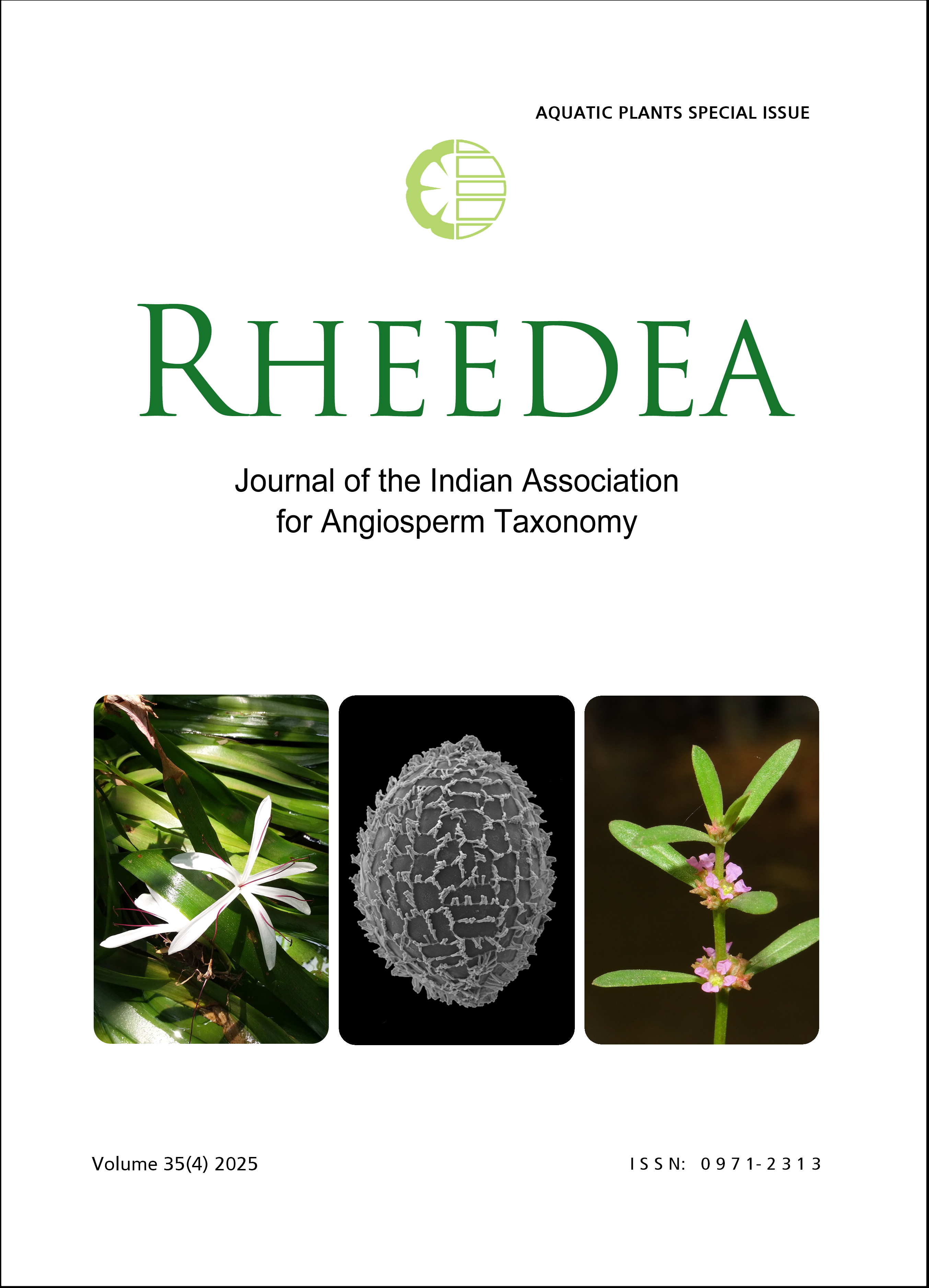
Main Article Content
Abstract
Podostemaceae, or “river-weeds,” are a diverse family of freshwater angiosperms adapted to fast-flowing tropical and subtropical rivers. With over 300 species, they exhibit remarkable morphological variation across regions, especially between New World and Old-World taxa. Their life-cycle is tightly synchronized with seasonal water levels, with flowering and seed production occurring as waters recede. These plants rely solely on sexual reproduction, making pollination a key evolutionary driver for diversification. Different pollination strategies, melittophily, anemophily, and self-pollination have been reported within the family. However, integration of floral morphology and pollination biology remains limited. Thus, an overview of reproductive characters in Podostemaceae is presented, focussing on characters that are useful in understanding the pollination strategies and functional floral morphology in the family. This review synthesizes current knowledge to explore how pollination systems and floral traits have shaped the evolutionary trajectory of Podostemaceae.
Article Details
Section

This work is licensed under a Creative Commons Attribution-NonCommercial-NoDerivatives 4.0 International License.
How to Cite




References
AMARAL M.C.E & V. BITTRICH 2013. Ochnaceae nom. cons. In: KUBITZKI K. (ed.), Flowering Plants. Eudicots: Malpighiales. Berlin, Heidelberg: Springer Berlin Heidelberg, 253–268. https://doi.org/10.1007/978-3-642-39417-1_19 DOI: https://doi.org/10.1007/978-3-642-39417-1_19
ANGIOSPERM PHYLOGENY GROUP 2016. An update of the Angiosperm Phylogeny Group classification for the orders and families of flowering plants: APG IV. Botanical journal of the Linnean Society 181(1):1–20. https://doi.org/10.1111/boj.12385 DOI: https://doi.org/10.1111/boj.12385
BARRETT S.C.H. & S.W. GRAHAM 2000. "7 Adaptive radiation in the aquatic plant. In: GIVNISH T.J. & K.J. SYTSMA (ed.), Molecular Evolution and Adaptive Radiation. Cambridge University Press, Camdridge.
BITTRICH V., AMARAL M.C.E., MACHADO S.M., ZACHARIAS M.E. & A.J. MARSAIOLI 2006. Oils, resins and the pollination biology of the Clusiaceae. Floriculture, Ornamental and Plant Biotechnology 4: 387–394.
BOVE C.P., PHILBRICK C.T., & W.J. COSTA 2011. Taxonomy, distribution and emended description of the neotropical genus Lophogyne. Brittonia 63: 156–160. https://doi.org/10.1007/s12228-010-9143-3 DOI: https://doi.org/10.1007/s12228-010-9143-3
CHEEK M., SÉNÉ O. & E. NGANSOP 2020. Three new Critically Endangered Inversodicraea (Podostemaceae) species from Tropical Africa: I. senei, I. tanzaniensis and I. botswana. Kew Bulletin 75(2): p.31. https://doi.org/10.1007/s12225-020-09889-1 DOI: https://doi.org/10.1007/s12225-020-09889-1
COOK C.D.K. & R. RUTISHAUSER 2007. Podostemaceae. In: KUBITZKI K. (ed.), The Families and Genera of Vascular Plants. Volume 9.Springer, Berlin. pp. 304–344.
COOK C.D.K. 1988. Wind pollination in aquatic angiosperm. Annals of Missouri Botanical Garden 75: 768–777. https://doi.org/10.2307/2399365 DOI: https://doi.org/10.2307/2399365
COOK C.D.K. 1990. Aquatic Plant Book. First edition. SPB Academic Publishing, The Hague.
COSTA T.M. 2016. Estratégias reprodutivas de Bonnetia stricta (Bonnetiaceae) presentes na mata ciliar do rio lençóis, chapada DIAMANTINA, BAHIA. Anais dos Seminários de Iniciação Científica 20(2016): XX Seminário de Iniciação Científica.
CUSSET C. & G. CUSSET 1988. Etude sur les Podostemales. 9. Délimitations taxinomiques dans les Tristichaceae. Adansonia 10: 149–177. DOI: https://doi.org/10.5962/p.276380
CUSSET C. 1987. Podostemaceae and Tristichaceae. In: SATABIÉ B. & P. MORAT (eds.), Flore du Cameroun. Volume 30. Ministère de l’Enseignement Supérieur et de la Recherche Scientifique, Yaoundé. pp. 51–99.
CUSSET C. 1992. Contribution à l’étude des Podostemaceae: 12. Les genres asiatiques. Adansonia 14: 13–54. DOI: https://doi.org/10.5962/p.276449
DA SILVA-BATISTA I.C., DA COSTA F.G.C.M., DE ASSUNÇÃO T.S., KOSCHNITZK C., VIEIRA R.C. & C.P. BOVE 2021. First report of osmophores and wet stigma in Podostemaceae with notes on floral biology and pollination of Weddellina squamulosa Tul. Flora 278:151799. https://doi.org/10.1016/j.flora.2021.151799 DOI: https://doi.org/10.1016/j.flora.2021.151799
DA SILVA-BATISTA I.C., KOSCHNITZKE C. & C.P. BOVE 2020. Reproductive assurance in three Neotropical species of Podostemaceae: strategies of self-pollination and the first report of apomixis. Hoehnea 47: e212019. https://doi.org/10.1590/2236-8906-21/2019 DOI: https://doi.org/10.1590/2236-8906-21/2019
DA SILVA-BATISTA I.C. 2019. PhD Thesis. Museu Nacional - Universidade Federal do Rio de Janeiro, Rio de Janeiro.
DE SÁ-HAIAD B., TORRES C.A., DE ABREU V.H.R., GONÇALVES M.R., MENDONÇA C.B.F., DE SANTIAGO-FERNANDES L.D.R., BOVE C.P. & V. GONÇALVES-ESTEVES 2010. Floral structure and palynology of Podostemum weddellianum (Podostemaceae: Malpighiales). Plant Systematics and Evolution 290: 141–149. https://doi.org/10.1007/s00606-010-0356-4 DOI: https://doi.org/10.1007/s00606-010-0356-4
ENDRESS P.K. 1996. Diversity and evolutionary biology of tropical flowers. Cambridge University Press. DOI: https://doi.org/10.1086/419297
FURNESS C.A. & P.J. RUDALL 2004. Pollen aperture evolution–a crucial factor for eudicot success? Trends in Plant Science 9(3): 154–158. https://doi.org/10.1016/j.tplants.2004.01.001 DOI: https://doi.org/10.1016/j.tplants.2004.01.001
FURNESS C.A. 2012. Pollen evolution in the clusioid clade (Malpighiales). International Journal of Plant Sciences 173(9):1055–1082. https://doi.org/10.1086/667614 DOI: https://doi.org/10.1086/667614
GESSNER F. & L. HAMMER 1962. Ökologische-physioilogische Untersuchungen ad den Podostemonaceen des Caroni. International Revue Gesamten Hydrobiologie 47: 497–541. https://doi.org/10.1002/iroh.19620470402 DOI: https://doi.org/10.1002/iroh.19620470402
GOODWILLIE C., KALISZ S. & C.G. ECKERT 2005. The evolutionary enigma of mixed mating systems in plants: occurrence, theoretical explanations, and empirical evidence. Annual Review of Ecology, Evolution, and Systematics 36: 47–79. https://doi.org/10.1146/annurev.ecolsys.36.091704.175539 DOI: https://doi.org/10.1146/annurev.ecolsys.36.091704.175539
GRUBERT M. 1974. Podostemaceen-Studien.Teil I. Zur Ökologie einiger venezolanischer Podostemaceen. Beitraegezur Biologie der Pflanzen 50: 321–391.
GUPTA C.K. & A. SEHGAL 2009. Pollination biology of Indotristicha ramosissima (Podostemaceae: Tristichoideae). Aquatic Botany 91: 51–56. https://doi.org/10.1016/j.aquabot.2009.02.005 DOI: https://doi.org/10.1016/j.aquabot.2009.02.005
JÄGER-ZÜRN I. 1997. Embryological and floral studies in Weddellina squamulosa Tul. (Podostemaceae, Tristichoideae). Aquatic Botany 57: 151–182. https://doi.org/10.1016/S0304-3770(96)01126-6 DOI: https://doi.org/10.1016/S0304-3770(96)01126-6
JÄGER-ZÜRN I. & C.J. MATHEW 2002. Cupule structure of Dalzellia ceylanica and Indotristicha ramosissima (Podostemaceae). Aquatic Botany 72: 79–91. https://doi.org/10.1016/S0304-3770(01)00221-2 DOI: https://doi.org/10.1016/S0304-3770(01)00221-2
JÄGER-ZÜRN I. 2005. Shoot apex and spathella: two problematical structures of Podostemaceae–Podostemoideae. Plant Systematics and Evolution 253: 209–218. https://doi.org/10.1007/s00606-005-0297-5 DOI: https://doi.org/10.1007/s00606-005-0297-5
KATAYAMA N., KOI S. & M. KATO 2010. Expression of SHOOT MERISTEMLESS, WUSCHEL, and ASYMMETRIC LEAVES1 homologs in the shoots of Podostemaceae: implications for the evolution of novel shoot organogenesis. Plant Cell 22: 2131−2140. https://doi.org/10.1105/tpc.109.073189 DOI: https://doi.org/10.1105/tpc.109.073189
KATO M., KATAYAMA N. & S. KOI 2022. Comparative morphology and evolution of Podostemaceae flower. Acta Phytotaxonomica et Geobotanica 73(2):97–106. https://doi.org/10.18942/apg.202120
KATO M., KITA Y. & S. KOI 2003. Molecular phylogeny, taxonomy and biogeography of Malaccotristicha australis comb. nov. (syn. Tristichaaustralis) (Podostemaceae) Australian Systematic Botany 16: 177–183. https://doi.org/10.1071/SB02020 DOI: https://doi.org/10.1071/SB02020
KATO M. 2006. Distribution and biogeography of Podostemaceae in Asia. Bulletin of the National Science Museum, Tokyo, Series B 32: 19–27.
KHANDURI P., CHANDRA A., ROY S.K. & R. TANDON 2024. Reproductive biology of Podostemum subulatum (Podostemaceae) reveals pre-anthesis cleistogamy. Plant Systematics and Evolution 310(6): 44. https://doi.org/10.1007/s00606-024-01928-9 DOI: https://doi.org/10.1007/s00606-024-01928-9
KHANDURI P., CHAUDHARY A., UNIYAL P.L. & R. TANDON 2014. Reproductive biology of Willisia arekaliana (Podostemaceae), a freshwater endemic species of India. Aquatic Botany 119: 57–65. https://doi.org/10.1016/j.aquabot.2014.06.008 DOI: https://doi.org/10.1016/j.aquabot.2014.06.008
KHOSLA C. & H.Y. MOHAN RAM 1993. Morphology of flower, fruit, seed in Polypleurum stylosum. Aquatic Botany 46: 255–262. https://doi.org/10.1016/0304-3770(93)90006-I DOI: https://doi.org/10.1016/0304-3770(93)90006-I
KHOSLA C., SHIVANNA K.R. & H.Y. MOHAN RAM 2000. Reproductive biology of Polypleurum stylosum (Podostemaceae). Aquatic Botany 67: 143–154. https://doi.org/10.1016/S0304-3770(99)00098-4 DOI: https://doi.org/10.1016/S0304-3770(99)00098-4
KHOSLA C., SHIVANNA K.R. & H.Y. MOHAN RAM 2001. Cleistogamy in Griffithella hookeriana (Podostemaceae). South African Journal of Botany 67: 320–324. https://doi.org/10.1016/S0254-6299(15)31135-2 DOI: https://doi.org/10.1016/S0254-6299(15)31135-2
KOI S., KITA Y., HIRAYAMA Y., RUTIHAUSER R., HUBER K.A. & M. KATO 2012. Molecular phylogenetics analysis of Podostemaceae: implications for taxonomy of major groups. Botanical Journal of the Linnean Society 169: 461–492. https://doi.org/10.1111/j.1095-8339.2012.01258.x DOI: https://doi.org/10.1111/j.1095-8339.2012.01258.x
KOI S., IKEDA H., RUTISHAUSER R. & M. KATO 2015. Historical biogeography of river-weeds (Podostemaceae). Aquatic Botany 127: 62–69. https://doi.org/10.1016/j.aquabot.2015.08.003 DOI: https://doi.org/10.1016/j.aquabot.2015.08.003
KOI S., UNIYAL P.L. & M. KATO 2022. A classification of the aquatic Podostemaceae subfamily Tristichoideae, with a new genus based on ITS and matK phylogeny and morphological characters. Taxon 71(2): 307–320. https://doi.org/10.1002/tax.12655 DOI: https://doi.org/10.1002/tax.12655
KRISHNAN R., KHANDURI P. & R. TANDON 2023. Development of pollen dyads in Polypleurum munnarense Nagendran & Arekal (Podostemaceae): Insights into the plant's reproductive strategy. Flora 305: 152331. https://doi.org/10.1016/j.flora.2023.152331KRISHNAN R., KHANDURI P. & R. TANDON 2019. Floral biology, pollination mechanism and embryo development in Zeylanidium maheshwarii (Podostemaceae). Vegetos 32(2):216–222. https://doi.org/10.1007/s42535-019-00025-4 DOI: https://doi.org/10.1007/s42535-019-00025-4
LOBREAU-CALLEN D., LE THOMAS A. & M. SUAREZ-CERVERA 1998. Ultrastructural features of the pollen of some podostémales. Affinities with advanced Rosidae = Ultrastructural characters of the pollen of some podostemales. Affinities with advanced Rosidae. Proceedings of the Academy of Sciences, Series 3 Life Science 321: 335–345. https://doi.org/10.1016/S0764-4469(98)80059-0 DOI: https://doi.org/10.1016/S0764-4469(98)80059-0
MARTARELLO N.S., FIDALGO A.D., ROSSI M.L., MARTINELLI A.P., DE OLIVEIRA F.F., CATHARINO E.L. & C.F. PINTO DA LUZ 2024. Pollen morphology and reproductive biology of Calophyllum brasiliense Cambess. (Calophyllaceae). Palynology 48(4): 2362465. https://doi.org/10.1080/01916122.2024.2362465 DOI: https://doi.org/10.1080/01916122.2024.2362465
MATHEW C.J. & V.K. SATHEESH 1997. Taxonomy and distribution of the Podostemaceae
in Kerela, India. Aquatic Botany 57: 243–274. https://doi.org/10.1016/S0304-3770(97)00006-5 DOI: https://doi.org/10.1016/S0304-3770(97)00006-5
MOHAN RAM H.Y. & A. SEHGAL 1992. Podostemaceae- the strange family of aquatic angiosperms. Palaeobotanist 41: 192–197. https://doi.org/10.54991/jop.1992.1122 DOI: https://doi.org/10.54991/jop.1992.1122
MOLINE P., THIV M., AMEKA G.K., GHOGUE J.P., PFEIFER E. & R. RUTISHAUSER 2007. Comparative morphology and molecular systematics of African Podostemaceae — Podostemoideae, with emphasis on Dicraeanthus and Ledermanniella from Cameroon. International Journal of Plant Sciences 168: 159–180. https://doi.org/10.1086/509607 DOI: https://doi.org/10.1086/509607
NOVELO R.A. & C.T. PHILBRICK 1993. A new species of Marathrum (Podostemaceae) from Jalisco, Mexico. Novon 3: 456–458. https://doi.org/10.2307/3391394 DOI: https://doi.org/10.2307/3391394
OKADA H. & M. KATO 2002. Pollination systems inferred from pollen-ovule ratio of some species of Podostemaceae. Acta Phytotaxonomica et Geobotanica 53: 51–61. https://doi.org/10.18942/apg.KJ00003256665
O'NEILL S.P., OSBORN J.M., PHILBRICK C.T. & R.A. NOVELO 1997. Comparative pollen morphology of five new world genera of Podostemaceae. Aquatic Botany 57: 133–150. https://doi.org/10.1016/S0304-3770(96)01125-4 DOI: https://doi.org/10.1016/S0304-3770(96)01125-4
PEREZ M.K., CAMACHO-VELÁZQUEZ A., JIMÉNEZ-DURÁN K., WONG J.G., YÁÑEZ-ORDÓÑEZ O. & J. MÁRQUEZ-GUZMÁN 2024. Osmophores, Volatiles, and Bees Reveal Ambophily in Marathrum rubrum (Podostemaceae). Available at SSRN 5047167. https://dx.doi.org/10.2139/ssrn.5047167 DOI: https://doi.org/10.2139/ssrn.5047167
PHILBRICK C.T. & D.H. LES 1996. Evolution of aquatic angiosperm reproductive systems. Bioscience 46: 813–826. https://doi.org/10.2307/1312967 DOI: https://doi.org/10.2307/1312967
PHILBRICK C.T. 1984. Aspects of floral biology, breeding system, and seed and seedling biology in Podostemum ceratophyllum (Podostemaceae). Systematic Botany 9: 166–174. https://doi.org/10.2307/2418821 DOI: https://doi.org/10.2307/2418821
RONSE DECRAENE L.P. & E.F. SMETS 2001. Staminodes: Their morphological and evolutionary significance. Botanical Review 67: 351–402. https://doi.org/10.1007/BF02858099 DOI: https://doi.org/10.1007/BF02858099
RUHFEL B.R., BITTRICH V., BOVE C.P., GUSTAFSSON M.H.G., PHILBRICK C.T., RUTISHAUSER R., XI Z. & C.C. DAVIS 2011. Phylogeny of the clusioid clade (Malpighiales): evidence from the plastid and mitochondrial genomes. American Journal of Botany 98: 306–325. https://doi.org/10.3732/ajb.1000354 DOI: https://doi.org/10.3732/ajb.1000354
RUTISHAUSER R. & K.A. HUBER 1991. The developmental morphology of Indotristicha ramosissima (Podostemaceae, Tristichoideae). Plant Systematics and Evolution, 178: 195–223. https://doi.org/10.1007/BF00937964 DOI: https://doi.org/10.1007/BF00937964
RUTISHAUSER R. & M. GRUBERT 1994. The architecture of Mourera fluviatilis: mature structures and leaf development. Botanica Helvetica 104: 179–194.
RUTISHAUSER R., PFEIFER E., NOVELO R.A. & C.T. PHILBRICK 2005. Diamantina lombardii - an odd Brazilian member of the Podostemaceae. Flora 200: 245–255. https://doi.org/10.1016/j.flora.2004.09.004 DOI: https://doi.org/10.1016/j.flora.2004.09.004
RUTISHAUSER R. 1997. Structural and developmental diversity in Podostemaceae (river-weeds). Aquatic Botany 57: 29–70. https://doi.org/10.1016/S0304-3770(96)01120-5 DOI: https://doi.org/10.1016/S0304-3770(96)01120-5
RUTISHAUSER R. 2016. Evolution of unusual morphologies in Lentibulariaceae (bladderworts and allies) and Podostemaceae (river-weeds): a pictorial report at the interface of developmental biology and morphological diversification. Annals of Botany 117(5):811–832. https://doi.org/10.1093/aob/mcv172 DOI: https://doi.org/10.1093/aob/mcv172
SCULTHORPE C.D. 1967. The Biology of Aquatic Vascular Plants.Edward Arnold Publishers limited, London.
SEHGAL A., KHURANA J.P., SETHI M. & A. HUSSAIN 2010. Occurrence of unique three celled megagametophyte and single fertilization in an aquatic angiosperm- Dalzellia zeylanica (Podostemaceae-Tristichoideae). Sexual Plant Reproduction 24: 199–210. https://doi.org/10.1007/s00497-010-0159-3 DOI: https://doi.org/10.1007/s00497-010-0159-3
SEHGAL A., SETHI M. & H.Y. MOHAN RAM 2009. Development of the floral shoot and pre-anthesis cleistogamy in Hydrobryopsis sessilis (Podostemaceae). Botanical Journal of the Linnean Society 159: 222–236. https://doi.org/10.1111/j.1095-8339.2008.00876.x DOI: https://doi.org/10.1111/j.1095-8339.2008.00876.x
SOBRAL-LEITE M., DE SIQUEIRA FILHO J.A., ERBAR C. & I.S. MACHADO 2011. Anthecology and reproductive systems of Mourera fluviatilis (Podostemaceae): Pollination by bees and xenogamy in a predominantly anemophilous and autogamous family? Aquatic Botany 95: 77–87. https://doi.org/10.1016/j.aquabot.2011.03.010 DOI: https://doi.org/10.1016/j.aquabot.2011.03.010
SOBRAL-LEITE M. 2009. MSc Thesis. Universidade Federal de Pernambuco, Pernambuco.
SOBRAL-LEITE M. 2013. PhD Thesis. Universidade Federal de Pernambuco, Pernambuco.
STEBBINS G.L. 1974. Flowering plants: evolution above the species level. Harvard University Press, Cambridge. DOI: https://doi.org/10.4159/harvard.9780674864856
TAVARES A.S. 1997. PhD. Thesis. Universidade Federal do Amazonas, Instituto Nacional de Pesquisas da Amazˆonia-INPA, Manaus.
VAN ROYEN P. 1954. The Podostemaceae of the New World. III. Acta Botanica Neerlandica 3(2): 215–263. DOI: https://doi.org/10.1111/j.1438-8677.1954.tb00297.x
WILLIS J.C. 1902. Studies in the morphology and ecology of the Podostemaceae of India and Ceylon. Annals of the Royal Botanic Gardens, Peradeniya 1: 267–465.
WURDACK K.J. & C.C. DAVIS 2009. Malpighiales phylogenetics: gaining ground on one of the most recalcitrant clades in the angiosperm tree of life. American Journal of Botany 90: 1151–1570. https://doi.org/10.3732/ajb.0800207 DOI: https://doi.org/10.3732/ajb.0800207